Seminar: The Reflexive Askēsis of Computer Gameplay as Ethico-Aesthetic Practice?
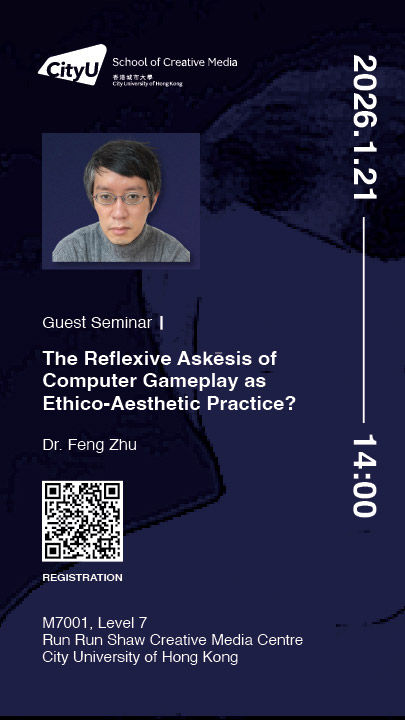
Seminar: Dr. Feng Zhu
21 January 2026
Many digital gameplay practices involve the player being reflexive about their own actions. They may attempt to bring non-conscious dispositions to awareness as part of transforming their own play – an essential aspect of the askēsis (training, practice, or development) involved in improving play. If Foucault remarked that “it is the forms of reflexivity that constitute the subject as such”, we may ask: what are the features of these forms of reflexivity associated with digital gaming and what kind of subject might they entrain? Could they hone a discerning familiarity with habituation itself – a task that is perhaps no less than, as Clare Carlisle has remarked, the work of philosophy? Could it even be possible in a way that the practitioner is able to attend to their own habit-formation in non-gaming spheres of life?
These lofty hopes resonate with the hopes that have been pinned on aesthetic self-fashioning by thinkers such as Foucault and Nietzsche. It is, however, arguably beset with formidable difficulties. We face an environmental entrainment of our habits and forms of reflexivity so that they that tethered to commodified practices that dispose us to be loyal consumers of a franchise. Neoliberal imperatives of individual responsibility prime us to prefer optimized strategies which yield quantifiable gains and to adopt off-the-shelf strategies. Yet there perhaps comes a point in highly accomplished gameplay practices where the experience of the player ineluctably moves them beyond these habits. This talk will examine Magic: the Gathering Arena (2019) limited draft as a case study from which to explore these questions and to think whether the forms of player reflexivity and judgment involved may be thought to feature an aesthetic dimension.